Author Archives: BrandFresh Magazine

WHAT IS: A Micro, Small, or Medium-sized Enterprise?

Many definitions exist to differentiate between micro, small and medium-sized businesses. However, there is no global agreement on the definitions, due to differences in the economic structures of countries.

Most countries utilize the state’s defi­nition of these businesses for extending credit, hence the different classifications amongst countries.

The European Union (EU) defines micro, small, and medium-sized enterprises (MSMEs) as businesses that employ between 1 and 249 persons and have up to 50 million Euro in annual turnover. However, to be so classified, these companies must have a maximum of 43 million Euro in their balance sheet total.

The United States of America defines MSMEs according to the number of employees the organization has, except for the non-goods producing sectors.

The World Bank has strict definitions for micro enterprises, small businesses, and medium-sized enterprises. They define a micro business as an organization with less than 10 employees and annual sales not exceeding US$100,000 and total assets not more than US$100,000.

A small business as defined by the World Bank is an enterprise with less than 50 employees, sales less than US$3 million per annum, and total assets less than US$3 million. The definition of medium-sized enterprises as defined by the World Bank are those organizations with 300 or less employees, annual sales of less than US$15 million, and total assets of less than US$15 million.

In Jamaica, MSMEs have several definitions. The Small Business Association of Jamaica (SBAJ) uses the number of employees and total sales as their benchmark. The Private Sector Organization of Jamaica (PSOJ) solely uses total annual sales as their base for defining MSMEs. The Planning Insti­tute of Jamaica (PIOJ) defines MSMEs based on total sales and total assets.

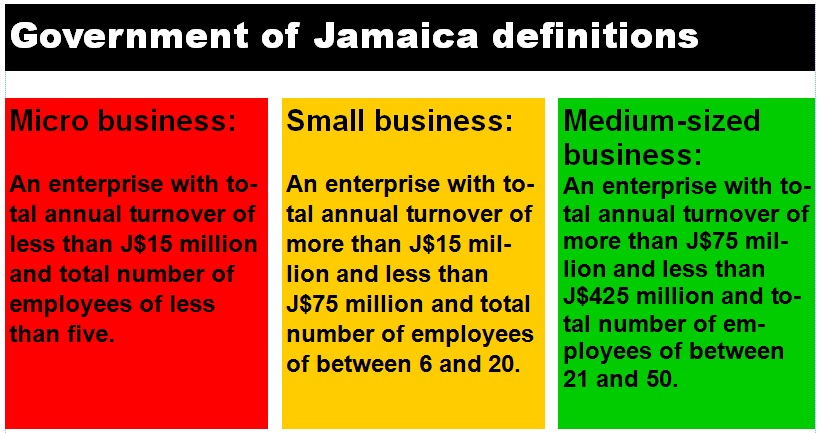
However, the Ministry of Industry, Investment and Commerce (MIIC) uses total annual sales and the number of employees as their criteria for defining MSMEs. Their policy formulation (2013) describes a micro business as having five or less employees with a maximum annual turnover of J$10 million.

A small business is classified as having 6 to 20 employees and having annual sales of over J$10 million but less than J$50 million.

And a medium-sized business is classified by MIIC as having 21 to 50 employees and annual sales of over J$50 million but less than J$150 million.
Celebrating the Reason for the SEASON

Over 25 years ago, during the Christmas Season of 1993, the late Monsignor Richard Albert told the story of ‘Miss Lena,’ a Jamaican senior citizen living in substandard conditions in the inner city, who taught him a valuable lesson about the “Real Meaning of Christmas”.

According to Father Albert, as he took his leave of Miss Lena after his usual visit with her, he said she assured him that she would be praying for him and “all the poor.” Then she gave him a small, crumpled piece of old newspaper and when he opened it, saw that it contained six $2 bills and a note which said: “Please buy a gift for someone.”

Over the years, every Christmas Season, I am reminded of this story told by the late, inimitable, Father Richard Albert and marvel at its simple, yet profound message.  Some 20 years later, during his final Christmas among the living, Father Albert still remembered Miss Lena and reiterated that: “Her gesture reminded me that Christmas is all about giving.

“It does not matter what or how much we give but The  Great Message of Christmas is that what is important in life, is that we give to each other.”

May the true reason for the Season guide all your hopes, dreams and actions this and every Christmas Season.

Best wishes to you and yours for a Safe & Happy holiday.

Restaurateurs Urged To Modify Business Model

By Rosheika Grant

JIS News

Food entrepreneurs, including restaurateurs, are being encouraged to modify their business model in order to stay afloat as patrons shift their dining habits due to the coronavirus (COVID-19).

Senior Food Technologist, Jamaica Business Development Corporation (JBDC), Treanna Lindo, said that reshaping processes is crucial to surviving the impact of the pandemic.

“Shifting your business model could mean offering takeout or facilitating contact-less, money-less delivery and kerbside pickup as most places aren’t offering to dine. But you have to facilitate people getting your product while adhering to safety guidelines,” she said.

She was addressing the virtual ‘JBDC Biz Zone’ on Tuesday (June 2), under the theme ‘Convenient Catering during COVID-19’.

Miss Lindo said that a comprehensive risk assessment should be done before any changes are made to the business model, which will better enable the operator to deal with any issues that arise.

“Also, ensure that you have stock control, as with COVID there are issues with raw materials. So, consistently check on your available raw materials when creating menus that you are offering during this period,” she advised, adding that the supply of items such as cling wraps and utensils should also be closely monitored.

Miss Lindo said that members of staff should be adequately trained in food health, safety and sanitisation, social distancing, and customer service.

She said that staff should be provided with personal protective equipment (PPE) particularly those working in high-contact areas, such as cashiers or hostesses.

Restaurateurs are also advised to ensure that tables are six feet apart and that waiting areas facilitate social distancing.
Miss Lindo further encouraged them to emphasise branding and make use of social media.

“It is important to maintain a social media presence. Use the platforms to advertise your offerings, with regular updates, post customer feedback and provide information on your menu and prices,” she said.

The webinar also highlighted simple, healthy and affordable food options that are convenient, and explored packaging options and considerations for food delivery.

The JBDC Biz Zone is a weekly series of webinars organised by the JBDC to provide business support and advice to micro, small, and medium-sized enterprises (MSMEs).

COVID-19: An Opportunity For MSMEs To Innovate

By Rosheika Grant

JIS News

Chief Executive Officer of the Jamaica Business Development Corporation (JBDC), Valerie Veira, says the outbreak of the novel coronavirus (COVID-19) provides an opportunity for micro, small and medium-sized enterprise (MSME) operators to find new ways to expand their services and meet the needs of their consumers/clients.

“It is now a time to do some serious reflection on how we do what we do and how to serve our clientele better. There has to be a way forward.

“We have to identify new services and products based on what we are experiencing at the moment, as new niches are coming, so we should look at identifying them, and looking at how we convert them into new businesses,” she added.

Ms Veira, who was speaking in an interview with JIS News, suggested that MSME operators should use this period to do research, which is crucial to product development.

Entrepreneurs are also encouraged to formalise their operations in order to be viable for opportunities and support.

“If the Government comes up with packages for support for MSMEs, we have to understand that it is important that you are formally recognised as a business. This is crucial for MSMEs as they reach out for assistance so it is also a time to reflect on that,” she added.

The JBDC is also urging MSMEs to make use of technology as they interface with clients/partners as well as embrace other distribution channels like e-commerce.

“We recently launched thingsjamaicanshopping.com and we intend to ramp up the marketing of that website to encourage consumers to shop online. If you are a local producer of authentic Jamaican products within our database, this is an excellent opportunity for you,” she said.

Ms. Veira told JIS News that the agency has been utilising the period of working from home to reflect on the agency’s programmes.

“Our officers have been charged to review the programmes that we have been offering; what new information we need to be sharing; new methodologies to institute, such as more webinars and more meetings being held via online platforms,” she noted. “As senior management, we have been considering how we can restructure, how we do things more efficiently, so we are using [this time] as a creative period to see how we can come up with these new approaches.

“We are looking to see if our information technology infrastructure is robust enough for us to provide this kind of new approach to service,” Ms. Veira added.

« Older Entries